The windings of a DC motor rotate within a DC magnetic field, inducing an alternating electromotive force (EMF). This alternating EMF is then converted into a direct current EMF via a commutation device. During operation, if an applied DC voltage overcomes the induced EMF to flow through the windings, electromagnetic power is input. After accounting for various losses, this power is converted into mechanical power at the motor's output shaft, driving the equipment. If the induced electromotive force overcomes the voltage drop across the windings to output direct current, an external power source must drive the motor shaft rotation. After accounting for various losses, this converts to electrical power output to the external circuit. The electromagnetic power in this case includes both the resistance losses in the armature windings and the electrical power output to the external circuit.
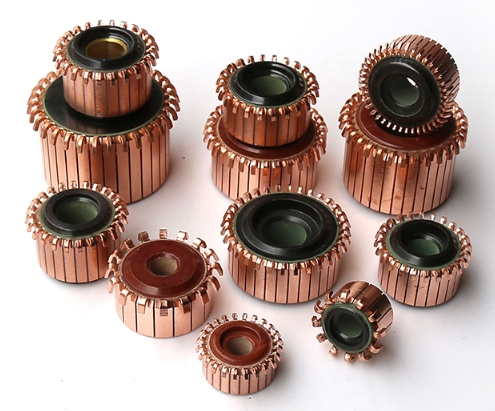
The poles of a DC motor are stationary. Direct current flowing through the pole coils generates a direct magnetic field, while the armature windings and commutator rotate synchronously. The stationary brushes, fixed relative to the poles, maintain constant sliding contact with the commutator. This ensures seamless connection between the DC external circuit and the AC internal winding.
The commutator comprises multiple commutator segments. These segments are mutually insulated by mica material and are also insulated from ground.
The armature windings of a DC motor consist of coil elements formed by insulated conductors, which are embedded in the slots of the armature core. These coils are connected to the commutator segments according to a specific pattern. Coil elements may be single-turn or multi-turn; generally, smaller capacity motors use multi-turn structures, while larger motors employ single-turn structures. The number of commutator segments is directly related to the number of slots in the motor.
When only one element edge occupies each slot layer, the number of commutator segments equals the number of slots. Symmetrical winding termination is achieved only when the center of the insulating segment aligns with the iron core slot or tooth centerline. In this case, placing the brush on the commutator segment beneath the main pole axis yields maximum potential, while the potential of the element short-circuited by the brush equals zero or approaches zero. When multiple element sides occupy each slot layer, it is impossible for every insulator center to align with the iron core slot. However, the centerlines of an integer pair of commutator segments must align with the iron core slot or tooth centerline. If assembly deviates from this rule, the brush position must be shifted by the same angular offset.
In practical applications, we observe that some DC motors have an odd number of commutator segments while others have an even number. This directly relates to the motor's slot count and winding type. For example, in single-wave winding motors, the armature slot count, the number of winding elements, and the number of commutator segments must all be odd numbers. Otherwise, after winding the armature, a closed circuit cannot be formed. Permanent magnet DC motors typically employ single-wave windings to increase armature resistance, hence their commutator segments are odd rather than even in number.
【Xinhui: 25 Years of Dedication in the Motor Equipment Industry】 Building on Quality, Founded on Integrity—Specializing in Customized Automated Motor Equipment Solutions! Specializing in the R&D and manufacturing of a full range of non-standard automated equipment, including stator/rotor winding machines, internal winding machines, automatic core punching machines, magnetic tile machines, carbon brush machines, and fan blade machines. Every piece of equipment adheres to the production standard of “Precision First, Durable and Reliable,” providing efficient and intelligent automated production solutions for motor manufacturers. We sincerely invite industry partners to inquire about collaboration and jointly build new heights in motor manufacturing!