
NEWS CENTER
- Home
- About us
- Products
- DC Motor Automatic line
- Series Motor Automatic Line
- Automatic Core Punching Machine
- Automatic Endplate Commutator All-In-One Machine
- Automatic Servo Groove Paper Machine
- Automatic Six-Station Winding Machine
- Manual Six-Station Winding Machine
- Manual Four-Station Winding Machine
- Automatic Servo Slotting Machine
- Automatic Double Station High Frequency Spot Welder
- Automatic Duplex Tester
- Automatic Double Knife Precision Turning Machine
- Visual Inspection Machine
- Automatic Rewinders
- Automatic Core Punching Machine
- Stator Stand-Alone Equipment
- Stator brushless equipment
- Non-Standard Equipment Spare Parts
- Motor Assembly Line
- Manual Motor Equipment
- Magnetic Tile Machine
- DC Motor Automatic line
- Application
- Service
- News
- Contact us

- Home
- About us
- Products
- DC Motor Automatic line
- Series Motor Automatic Line
- Automatic Core Punching Machine
- Automatic Endplate Commutator All-In-One Machine
- Automatic Servo Groove Paper Machine
- Automatic Six-Station Winding Machine
- Manual Six-Station Winding Machine
- Manual Four-Station Winding Machine
- Automatic Servo Slotting Machine
- Automatic Double Station High Frequency Spot Welder
- Automatic Duplex Tester
- Automatic Double Knife Precision Turning Machine
- Visual Inspection Machine
- Automatic Rewinders
- Stator Stand-Alone Equipment
- Stator brushless equipment
- Non-Standard Equipment Spare Parts
- Motor Assembly Line
- Manual Motor Equipment
- Magnetic Tile Machine
- Application
- Service
- News
- Contact us


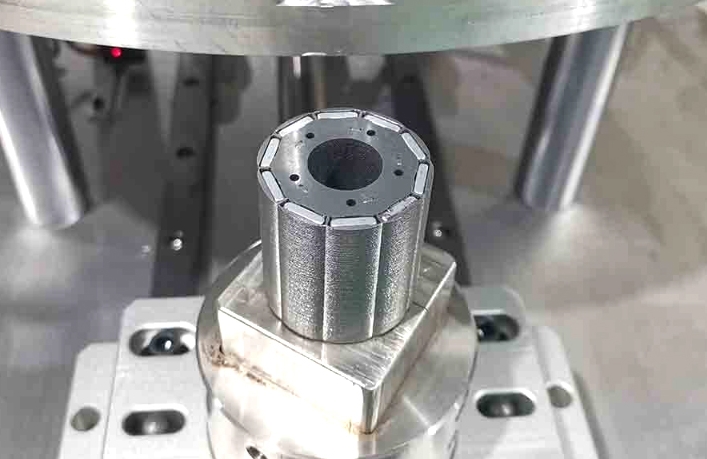
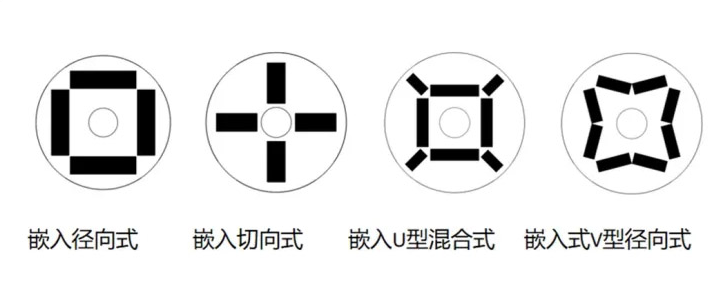 On the downside, first, **design and manufacturing complexity is higher**. Precise magnet slots must be formed in the rotor laminations, requiring strict mold accuracy, lamination stacking processes, and assembly consistency, which increases production costs. Second, as magnets are wrapped inside the iron core, the **heat dissipation path is longer**, making it difficult for heat to dissipate quickly. Prolonged high-load operation may cause excessive local temperature rise, degrading magnetic properties and even leading to demagnetization risk. In terms of later maintenance, once magnets are damaged or fail, disassembly and replacement are difficult, and repair costs are significantly higher than those of the surface-mounted structure.
The above summarizes the advantages and disadvantages of the embedded magnet rotor design. At present, this structure is widely adopted in many new energy vehicle drive motors.
On the downside, first, **design and manufacturing complexity is higher**. Precise magnet slots must be formed in the rotor laminations, requiring strict mold accuracy, lamination stacking processes, and assembly consistency, which increases production costs. Second, as magnets are wrapped inside the iron core, the **heat dissipation path is longer**, making it difficult for heat to dissipate quickly. Prolonged high-load operation may cause excessive local temperature rise, degrading magnetic properties and even leading to demagnetization risk. In terms of later maintenance, once magnets are damaged or fail, disassembly and replacement are difficult, and repair costs are significantly higher than those of the surface-mounted structure.
The above summarizes the advantages and disadvantages of the embedded magnet rotor design. At present, this structure is widely adopted in many new energy vehicle drive motors.