I. Introduction
With the rapid advancement of artificial intelligence, materials science, and precision manufacturing technologies, humanoid robots are gradually transitioning from laboratory prototypes to real-world applications. Their core component—the drive motor—directly determines the robot's motion performance, energy consumption levels, and dynamic response capabilities. Robotic drive systems can be categorized into three main types based on their drive mechanisms: hydraulic drive, pneumatic drive, and electric motor drive. Among these, electric motor drive has become the mainstream solution for humanoid robots due to its advantages of high precision, high efficiency, and ease of control.
II. Overview of Robotic Drive Mechanisms
1. Hydraulic Drive: Utilizes a liquid medium (such as hydraulic oil) to transmit power through a hydraulic pump and valve control system. Its advantages include high output torque and rapid response speed, making it suitable for large, heavy-duty robots (e.g., industrial material handling robots). However, it suffers from system complexity, susceptibility to leaks, and high maintenance costs.
2. Pneumatic Drive: Relies on compressed air to generate power, offering benefits such as cleanliness and explosion resistance. It is commonly used in scenarios requiring high protective standards, such as medical assistance robots. However, it has low power density and limited control precision.
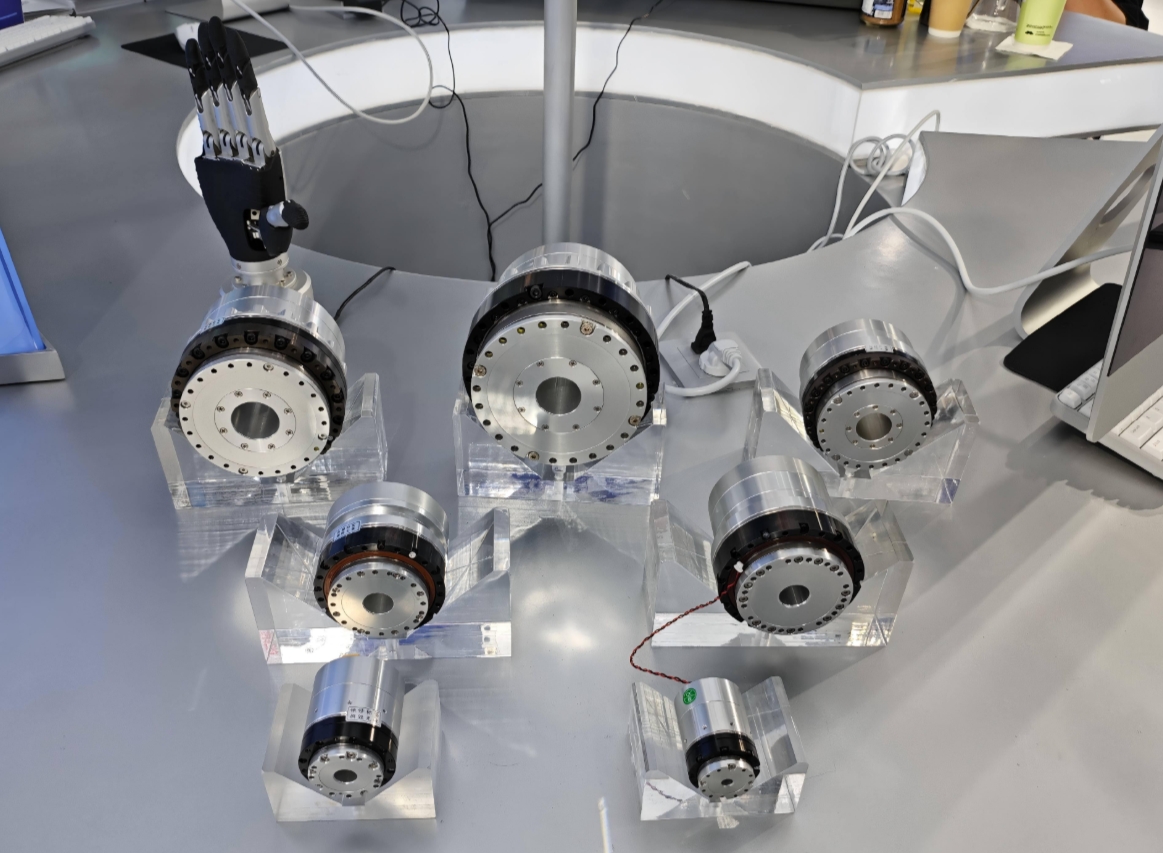
3. Electric Motor Drive: Converts electrical energy into mechanical energy, offering high control precision, rapid dynamic response, and superior energy efficiency. This is currently the most widely adopted drive method in humanoid robotics. The following sections will focus on the detailed classifications of electric motor drives.
III. Classification and Functional Characteristics of Humanoid Robot Drive Motors
1. Servo Motors
• Technical Overview:
• Servo motors are closed-loop control motors that utilize built-in encoders to provide real-time feedback on position, speed, or torque signals, forming a closed-loop regulation system with the controller. Current mainstream servo motors employ Permanent Magnet Synchronous Motor (PMSM) technology, combined with high-precision sensors (e.g., optical encoders) and advanced control algorithms (e.g., FOC vector control), to achieve micrometer-level positioning accuracy.
• Key Features:
• High Precision: Positioning error controlled within ±0.01°, with repeatability reaching micrometer-level accuracy.
• Rapid Dynamic Response: Response time under 1 ms, acceleration up to 10,000 rad/s².
• Strong Overload Capacity: Short-term overload capability reaching 3-5 times rated torque.
• Application Scenarios:
• Primarily used for large-joint drives in humanoid robots, such as shoulder, elbow, and knee joints. These areas require high-load capacity and high-frequency, high-precision motion. Servo motors achieve precise force control and trajectory tracking through high-rigidity transmission chains (e.g., harmonic reducers).
• Recent Advancements (as of September 15, 2025):
The new generation of servo motors employs multi-loop coordinated control technology (position-velocity-torque triple-loop closed-loop) and integrates temperature compensation algorithms to address thermal drift during prolonged operation. Additionally, some high-end models utilize carbon fiber winding technology, boosting power density to over 5 kW/kg.
2. Hollow Cup Motors
• Technical Overview:
• Hollow-cup motors are miniature DC servo motors featuring an ironless rotor design (typically hollow cup-shaped windings), eliminating traditional iron core eddy current losses. They utilize neodymium iron boron magnets to achieve high magnetic energy product.
• Key Features:
• High Efficiency & Energy Savings: Efficiency exceeds 85%, significantly surpassing traditional brushed motors (60%-70%).
• Lightweight: Power density reaches 1.5 kW/kg, reducing weight by 50% compared to standard motors of equivalent power.
• Low Inertia: Extremely low rotor inertia enables start/stop response times under 10 ms.
• Application Scenarios:
• Primarily used in end effectors of humanoid robots, such as dexterous finger joints. These components require precise manipulation (e.g., grasping, pinching) within confined spaces while operating with minimal vibration and noise.
• Recent Advancements:
• The third-generation hollow-cup motor released in 2025 employs printed circuit board (PCB) stator technology, further reducing axial dimensions while supporting a short-duration peak torque multiplication mode (0.1–0.5 s) to handle sudden load demands.
3. Stepper Motors
• Technology Overview:
• Stepper motors operate as open-loop control devices, driving segmented rotor rotation via pulse signals (each pulse corresponding to a fixed angle). Hybrid stepper motors (combining permanent magnet and variable reluctance characteristics) dominate the market, while microstepping technology enables ultra-fine control (achieving up to 51,200 steps per revolution).
• Key Features:
• Simple Structure: Enables position control without encoders, offering lower cost.
• High Torque at Low Speed: Maintains constant torque output within low-speed ranges.
• High Reliability: Brushless design eliminates wear, with a lifespan exceeding 100,000 hours.
• Suitable Applications:
• Ideal for components requiring moderate precision and low-frequency motion, such as the waist rotation joint and neck pitch joint in humanoid robots. These areas operate at low speeds and require static self-locking (e.g., maintaining head posture).
• Technical Limitations and Improvements:
• Traditional stepper motors suffer from high vibration noise and high-speed loss of synchronization. New stepper motors introduced after 2024 utilize closed-loop encoder feedback (pseudo-servo mode), enhancing positioning accuracy to ±0.05° while reducing vibration through resonance suppression algorithms.
4. Frameless Torque Motor
• Technical Overview:
The frameless torque motor eliminates the traditional housing, bearings, and output shaft, retaining only the stator and rotor assemblies. It can be directly embedded within the joint and integrated with the gearbox. Its operating principle resembles that of a direct drive motor (DD Motor) but offers higher torque density.
• Key Features:
• High Integration: Designed as a single unit with the joint structure, improving space utilization by over 40%.
• Zero-Backlash Transmission: Eliminates transmission chains, avoiding gear meshing errors.
• High Torque Density: Peak torque exceeds 500 Nm, achieving a torque density of 15 Nm/kg.
• Application Scenarios:
• Primarily used in high-torque, space-constrained joints like hips, knees, and shoulders. These areas require high torque output in compact spaces while supporting explosive movements (e.g., jumping, climbing).
• Recent Advancements:
• By 2025, the industry will adopt liquid-cooled frameless motors. Integrated micro-channels boost cooling efficiency by 200%, resolving overheating during sustained high-speed operation. Segmented winding designs enable fault tolerance (reduced-rated operation persists even with single-phase failure).
5. Axial Flux Motors
• Technical Overview:
• Axial flux motors (AFPM) feature a magnetic flux direction parallel to the motor shaft, with stator and rotor arranged in dual-disc or multi-disc opposing configurations. Their axial air gap magnetic field distribution shortens magnetic circuit length and reduces reluctance losses compared to traditional radial flux motors.
• Key Features:
• Ultra-high power density: Achieves up to 10 kW/kg, exceeding servo motors by over 3 times.
• Flattened structure: Reduces axial dimensions by 50%, ideal for joint integration.
• Broad high-efficiency range: Maintains over 90% efficiency across 20%-95% load.
• Suitable Applications:
• Ideal for high-torque areas with extreme weight and space constraints, such as leg joints (hip, knee, ankle) and shoulder composite joints. These components require frequent start-stop cycles and withstand impact loads; the high dynamic performance of axial flux motors significantly enhances motion capabilities.
• Technical Challenges and Progress:
• As of September 15, 2025, AFM costs remain approximately 2-3 times higher than conventional motors, primarily due to substantial permanent magnet usage and complex manufacturing processes (requiring segmented skewed-pole technology). Additionally, thermal management relies on ceramic substrate heat conduction or oil cooling solutions. This technology has been piloted in next-generation humanoid robot leg drives, with cost reductions anticipated post-2026 as supply chains mature.
IV. Comprehensive Comparison of Suitable Scenarios and Selection Principles
• Selection of drive motors for humanoid robots requires comprehensive consideration of the following factors:
1. Load Characteristics: High-inertia joints (e.g., hips) should prioritize frameless torque motors or axial flux motors; precision manipulation areas (e.g., fingers) should use hollow cup motors.
2. Dynamic Response: High-speed joints (e.g., elbows) require high-response servo motors; low-speed joints (e.g., necks) may use stepper motors.
3. Space Constraints: Compact joints (e.g., ankle) suit axial flux motors or frameless motors; unrestricted spaces may use standard servo motors.
4. Energy Efficiency Requirements: High-frequency motion areas (e.g., knee joint) require high-efficiency motors (e.g., hollow cup or axial flux motors) to minimize thermal losses.
V. Future Development Trends
1. Hybrid Drive Solutions: Single joints integrating multiple motor types (e.g., servo motor + hollow cup motor) enable coordinated high/low-speed control.
2. Material Innovation: Non-rare-earth permanent magnets (e.g., iron-nitrogen permanent magnets) and carbon nanotube winding technology promise further weight reduction and cost savings.
3. Thermal Management Revolution: Phase change material (PCM) cooling and microchannel liquid cooling will become standard configurations for high power density motors.
4. Intelligent Integration: Motor bodies will integrate vibration sensors, temperature sensors, and self-diagnostic algorithms to enable predictive maintenance.