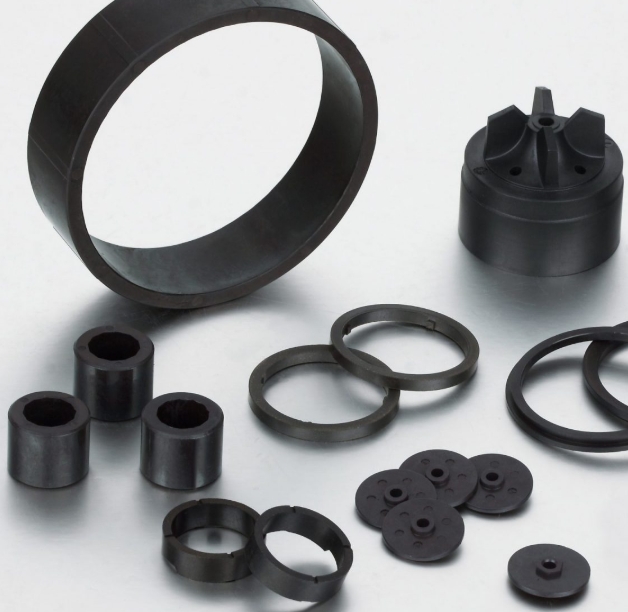
In modern motors, sensors, automotive components, and consumer electronics, two commonly used types are injection-molded (rubber/plastic) magnets and bonded permanent magnets. Although both fall under the category of “bonded magnets,” they exhibit significant differences in manufacturing processes, forming methods, performance characteristics, and application directions. The following provides a detailed introduction.

Both injection-molded (rubber/plastic) magnets and bonded permanent magnets belong to the “bonded magnet” category, yet they differ in material composition and application focus. Injection-molded magnets are formed by mixing magnetic powder with thermoplastic materials (e.g., PA, PPS) through injection molding. Typically containing 45-65% magnetic powder, they emphasize structural precision and overall toughness. Bonded permanent magnets, however, combine magnetic powder with a binder (epoxy, nylon) and are formed through pressing. They feature a higher magnetic powder content (65-80% or even higher), prioritizing magnetic performance over structural complexity.
Injection-molded magnets utilize the injection molding process: mixing → pelletizing (required for some products) → injection molding → magnetization. Their key features include high one-step molding efficiency, capability to produce complex shapes, and the ability to integrate cores with shafts or plastic skeletons in a single injection.
Bonded permanent magnets rely more on pressing or molding processes: mixing → pressing → curing → machining → magnetization. This method is suitable for producing magnetic rings with higher density and stronger magnetic properties.
Magnetic performance is the most significant difference between the two. Injection-molded magnets, with their high plastic matrix content and low magnetic powder density, typically achieve magnetic energy products around 5-8 MGOe. In contrast, bonded permanent magnets (especially molded NdFeB) offer higher densities, achieving magnetic energy products of 10-12 MGOe or higher. Consequently, bonded permanent magnets are the preferred choice for applications requiring strong magnetic fields, multi-pole circuits, and high output torque.
Regarding performance and molding, injection-molded magnets offer superior mechanical properties, high toughness, impact resistance, and dimensional accuracy. The injection molding process easily achieves complex structures like locating pins, snap-fits, and insert molding, making them ideal for monolithic magnetic rings, shafted magnets, or complex sensor magnetic components. Bonded magnets have lower mechanical strength and higher brittleness, generally unsuitable for overly intricate shapes.
Regarding cost, injection-molded magnets incur higher tooling expenses but offer rapid forming efficiency, high automation, and suitability for mass production, resulting in lower per-unit costs. Bonded magnets, due to their high magnetic powder content, slower forming speeds, and often requiring secondary processing, generally have higher overall costs than injection-molded magnets. In applications, injection-molded magnets are widely used in precision structural components such as ABS sensor rings, encoders, locks, and micro motors. Bonded permanent magnets are better suited for applications demanding high magnetic performance, such as brushless motor rotor rings, multipole rings, automotive pumps, and instrumentation.
The above outlines the comparative differences between injection-molded (rubber/plastic) magnets and bonded permanent magnets.