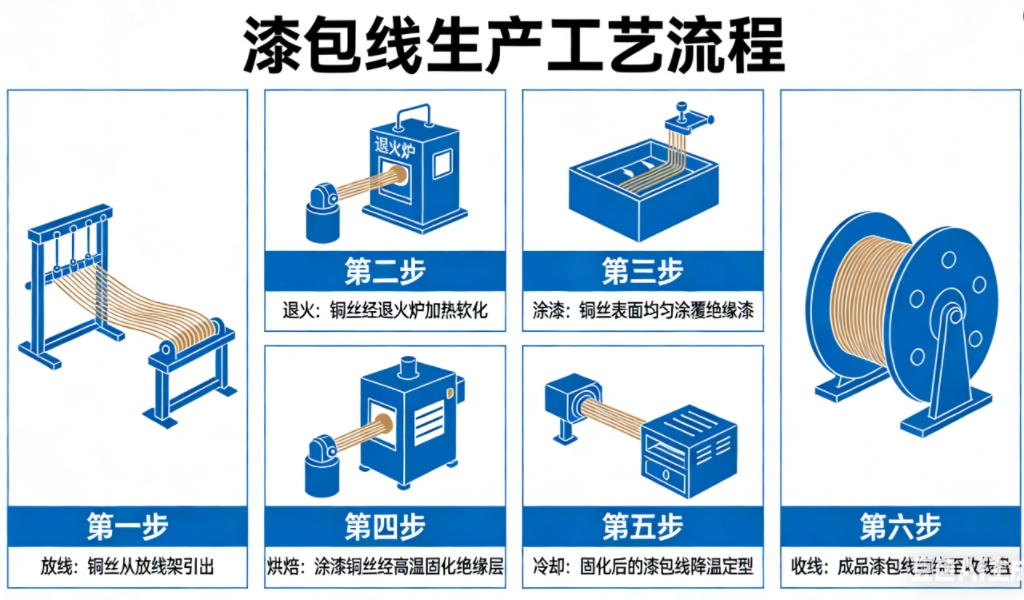
Production Process Flow for Enameled Wire, Including Core Functions and Key Control Points for Each Stage to Facilitate On-Site Operational Guidance:
I. Preliminary Preparation and Wire Paying
1. Raw Material Selection: Choose high-purity copper rod/aluminum rod; determine conductor material and initial wire diameter based on product specifications;
2. Drawing (if required): Gradually draw the metal rod through multi-stage drawing dies to produce bare wire with precise diameter while controlling surface finish;
3. Payoff: Smoothly load the drawn bare wire onto payoff reels and feed it to the annealing unit with constant, low-fluctuation tension to prevent conductor bending or scratching.
II. Annealing Treatment
Removes internal stresses generated during wire drawing to restore conductor flexibility; simultaneously cleans residual lubricants and oil contaminants to enhance subsequent paint adhesion. Typically performed in sealed annealing furnaces using controlled heating with protective atmospheres (e.g., nitrogen), followed by controlled cooling. Temperature and duration are precisely set based on wire diameter and material.

Annealing Equipment
III. Enameling + Baking (Core Cyclic Process)
1. Painting: Utilizing mold painting/felt painting to uniformly apply insulating paint onto clean conductor surfaces; single-pass thick coating is strictly prohibited. Typically requires 6–12 multi-layer thin coats, with each application controlling paint layer thickness and uniformity. Paint viscosity must match wire diameter (high-viscosity paint for thick wires, low-viscosity paint for thin wires);
2. Baking Curing: Immediately enter the oven after each coating application. Low-temperature evaporation removes solvents, followed by high-temperature cross-linking and curing of the paint base. Oven temperature is zonally controlled while ensuring orderly exhaust gas removal. The coating-baking cycle continues until the total paint film thickness meets specifications.
IV. Cooling + Lubrication + In-line Inspection
1. Cooling: High-temperature wire exiting the oven undergoes rapid water/air cooling to prevent coating scratches or softening at guide rollers.
2. Lubrication: Apply a uniform, light coating of specialized lubricant to enhance surface smoothness, facilitating tight winding and preventing wire adhesion.
3. In-line Inspection: Laser diameter gauges monitor wire diameter and coating thickness in real time, while breakdown voltage and visual inspections run concurrently with automatic alerts for anomalies.
V. Winding + Final Inspection + Packaging & Storage
1. Winding: Wind wire onto standard spools with stable tension and orderly arrangement;
2. Comprehensive Quality Inspection: Includes appearance, dimensions, coating adhesion, scratch resistance, electrical insulation strength, temperature rating, etc.;
3. Packaging & Storage: Qualified products are labeled, sealed in moisture-proof packaging, and stored by batch.
Complete Process Flowchart
Raw Materials (Copper/Aluminum Rod) → Wire Drawing → Payoff → Annealing → (Multiple Cycles: Coating → Baking) → Cooling → Lubrication → In-line Inspection → Take-up → Final Inspection → Packaging & Storage