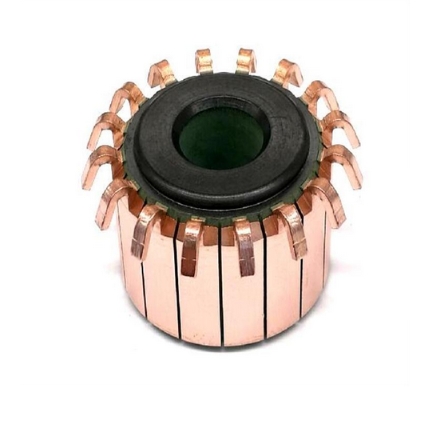
As a critical component in DC motors and certain AC motors (such as series-wound motors), the performance of the motor commutator directly impacts the overall motor performance. The following provides a detailed analysis of how the commutator affects motor performance in terms of efficiency, lifespan, stability, noise, and spark control.
I. Impact on Efficiency
Energy Loss Mechanisms
Resistance Losses: The commutator consists of multiple copper segments. Contact resistance between segments and brush resistance cause electrical energy loss.
Sparking Losses: Poor contact between brushes and commutator segments generates sparks. Spark energy dissipates as heat, reducing motor efficiency.
Friction Losses: Friction between brushes and commutator segments consumes mechanical energy.
Efficiency Comparison
Brushed Motors: Typically achieve 75%-85% efficiency, with commutator losses accounting for 20%-30% of total losses.
Brushless Motor: Efficiency can reach 85%-95%. Without mechanical commutation components, losses are significantly reduced.

II. Impact on Lifespan
Wear and Lifespan
Brush Wear: Brushes are consumable parts whose lifespan directly affects motor longevity. Typical brush life is 2000-5000 hours.
Commutator Wear: Surface wear on commutator segments causes poor contact, accelerating brush wear and shortening motor lifespan.
Lifespan Comparison
Brushed Motors: Average lifespan of 2,000–5,000 hours; commutator failures account for over 60% of total motor failures.
Brushless Motors: Lifespan exceeding 10,000 hours; no mechanical commutation components, resulting in low maintenance costs.
III. Stability Impacts
Speed Fluctuations
Poor Commutation: Inadequate brush-commutator contact causes current fluctuations, leading to unstable speed.
Load Variations: When commutator performance is insufficient, the motor may experience sudden speed drops or loss of synchronization during load changes.
Torque Fluctuations
Spark Interference: Sparks generate electromagnetic interference, affecting the smoothness of torque output.
Mechanical Vibration: Rectifier imbalance causes motor vibration, further compromising stability.
IV. Noise Impact
Noise Sources
Mechanical Noise: High-frequency noise generated by brush-commutator friction.
Electromagnetic Noise: Electromagnetic vibrations caused by sudden current changes due to poor commutation.
Noise Comparison
Brushed Motors: Noise levels typically range from 60-80 dB, with the commutator being the primary noise source.
Brushless Motors: Noise levels below 50 dB, with no mechanical friction noise.
Analogy: Brushed motor noise resembles a “hissing” sound, while brushless motor noise resembles a “humming” sound.
V. Spark Control Impact
Spark Level
Level 1 Spark: Weak sparking with negligible impact on motor performance.
Level 2 Spark: Noticeable sparking that may cause commutator segment erosion.
Level 3 Spark: Intense sparking that may trigger short circuits or motor damage.
Spark Control Measures
Optimize brush pressure: Ensure uniform contact between brushes and commutator segments.
Improve commutator surface: Reduce contact resistance through polishing or plating.
Select appropriate materials: Use copper-graphite composite brushes to minimize sparking.
Case Study: By adjusting brush pressure, a printing press motor reduced sparking from Level 2 to Level 1, lowering failure rates by 70%.
VI. Conclusion
The impact of motor commutators on motor performance primarily manifests in efficiency, lifespan, stability, noise, and spark control. Although brushed motors remain widely used in certain applications due to their low cost, their performance limitations are evident. With the maturation of brushless motor technology, electronic commutation is progressively replacing traditional mechanical commutators as the solution for high-performance motors. For applications requiring brushed motors, optimizing commutator design and material selection can significantly enhance motor performance.