During the winding process on a flying-fork winding machine, ensuring the stability of the coils is key to guaranteeing product quality (such as consistency in electrical performance, mechanical strength and aesthetic appearance). This requires comprehensive measures across multiple aspects, including equipment design, process parameter settings, tooling and fixtures, and operational control:
The following are the core measures for ensuring stability:
1. Precise wire tension control:
• Closed-loop tension control system: This is the most critical factor. The system must monitor wire tension in real time and automatically adjust the resistance of the pay-off/feed mechanism via a servo motor or electromagnetic damper to maintain tension at a preset, constant optimum value.
• Optimisation of tension setpoints: Excessive tension can lead to wire stretching and deformation, damage to the insulation layer, or even wire breakage; insufficient tension results in loose coils that are prone to deformation and irregular wire arrangement. The tension value must be finely adjusted according to the wire material, diameter, insulation properties, winding speed and coil shape.
• Multi-stage guide pulleys and tensioners: Multiple guide pulleys are used to guide the path, and precision mechanical or electronic tensioners are installed at critical points along the route (particularly before entering the rotating fork area) to ensure that the tension is stable and smooth as the wire enters the winding area.
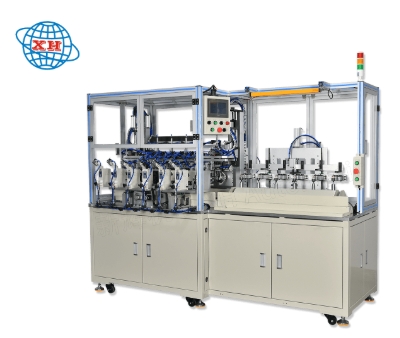
2. Optimised fly-fork motion trajectory and speed control:
• Smooth acceleration and deceleration curves: The acceleration and deceleration processes during the fly-fork’s rotation start-up, stopping and direction changes must be controlled using a smooth S-curve algorithm. Abrupt starts and stops generate significant inertial impacts, which compromise the stability of the already wound coils, leading to loosening, deformation or even wire slippage.
• Precise angular displacement control: The servo motor drives the fly fork, ensuring that the angle of each rotation (corresponding to the number of turns wound) is highly precise, thereby preventing cumulative errors that could lead to misalignment of the wire.
• Speed synchronisation: The winding speed (rotary fork speed) must be precisely synchronised with the movement speed of the wire-laying mechanism to ensure that the wire is arranged evenly and tightly on the bobbin or mould.
3. Precision and robust tooling fixtures (moulds):
• High-rigidity, low-deformation design: The winding bobbin or mould itself must possess sufficient rigidity and precision, with minimal deformation when subjected to winding tension and the forces exerted by the rotary fork.
• Precise positioning and secure clamping: The positioning of the bobbin/mould on the machine worktable must be absolutely accurate and clamped very securely to eliminate any minute displacement or vibration. Precision locating pins and powerful pneumatic/hydraulic clamps are typically used.
• Appropriate baffle/guard plate design: For coils or frames with complex shapes (e.g. irregular shapes, with protrusions or recesses), precision baffles, guard plates or adjustable stop devices must be designed to provide physical support and restraint for the wound section during the winding process, preventing the wire from slipping, popping out or accumulating in unintended positions under tension. The shape, angle and position of the baffles must perfectly match the coil design.
4. Advanced wire-laying mechanism:
• Precision ball screw/linear motor drive: The wire-laying mechanism (the device that guides the wire in an axial direction) requires high-precision drive systems (such as ball screws) or direct-drive linear motors to ensure precise and smooth movement.
• Precise synchronisation with the fly fork’s movement: The movement of the wire-laying mechanism must be programmed to synchronise precisely and in real time with the fly fork’s angle of rotation (or number of turns). This is typically coordinated by the machine’s CNC control system, ensuring that the wire is arranged tightly, evenly and layer by layer.
• Suitable wire-laying nozzles: The bore diameter, shape and material (e.g. ceramic to reduce wear) of the wire-laying nozzles must be matched to the wire diameter, enabling smooth wire passage whilst providing a degree of guidance and restraint.
5. Auxiliary stabilisation measures:
• Electrostatic eliminators: During high-speed winding, friction between wires can easily generate static electricity, which attracts dust or causes the wires to repel one another or become entangled. Install static elimination devices such as ionising air bars.
• Wire lubrication/coating: For certain specialised wires (such as large-cross-section flat wires or self-adhesive wires), it may be necessary to apply a small amount of specialised lubricant or coating before or during the winding process to reduce friction, improve wire feeding, and enhance adhesion during subsequent curing (for self-adhesive wires).
• Hot-air assistance (for self-adhesive wire): When winding self-adhesive enamelled wire, applying hot air at a controlled temperature near the winding fork or wire guide can slightly activate the adhesive properties of the enamel coating, allowing the coil to begin bonding and taking shape during the winding process, thereby significantly enhancing inter-layer adhesion and overall stability. This is a key method for ensuring the stability of self-adhesive wire coils.
• Environmental control: Maintain a clean working environment (to minimise dust interference) and ensure suitable temperature and humidity levels (to prevent changes in wire properties or the formation of condensation).
6. Process Monitoring and Quality Inspection:
• Real-time tension monitoring and alarms: Continuously display the tension curve; automatically trigger an alarm and halt the machine if limits are exceeded.
• Visual Inspection System: Utilises CCD cameras to monitor, either in real time or via spot checks, the neatness of wire arrangement during the winding process, as well as the presence of skipped wires, pinched wires or overlapping wires.
• Wire Break Detection: Sensitive sensors ensure immediate machine shutdown in the event of a wire break.
• Precise Turn Counting: High-precision encoders ensure absolute accuracy in the number of turns per layer and per group.
The key to ensuring the stability of coils produced by a flying-fork winding machine lies in constant and precise tension control, smooth and accurate movement of the flying fork, perfect synchronisation between the wire-laying mechanism and the flying fork, and precision jigs that provide firm support and restraint for the coils. At the same time, auxiliary processes (such as hot air) and environmental control tailored to specific materials (e.g. self-adhesive wire) are also crucial. Modern flying-fork winding machines achieve the highly integrated and optimised functioning of these elements through precise servo control, closed-loop feedback systems and intelligent CNC programming, enabling the consistent and stable production of high-quality coils in high-volume manufacturing. Operators must have a thorough understanding of these principles and carry out meticulous parameter tuning and jig preparation in accordance with the specific product.