Multi-pole ring magnets are specialised magnets with a unique magnetic field structure. Unlike conventional magnets, which have only basic north and south poles, they feature multiple magnetic poles distributed around the circumference of the ring, forming a complex array of magnetic poles.
Taking into account industry applications, the characteristics and uses of the three main types of multi-pole ring magnets are as follows:
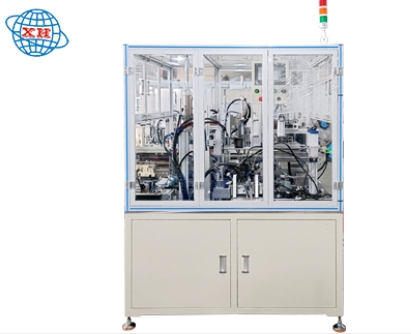
Xinhui Electromechanical: Magnetisation Machine
1. Radial Multi-pole Ring Magnets (Mainstream Model for General Motors)
In this type of ring magnet, the magnetic field is distributed along the radius of the ring, with N and S poles alternating on the outer and inner surfaces. There are two manufacturing processes: external magnetisation and internal magnetisation. External magnetisation is suitable for external rotor brushless motors, whilst internal magnetisation is suitable for internal rotor fan motors. The air-gap magnetic field approximates a sine wave, offering significant operational advantages: torque ripple in magnet-based designs typically ranges from 8% to 12%, whereas in monolithic multi-pole ring magnets it is only 3% to 5%. This effectively reduces cogging torque, resulting in smoother and quieter operation of the equipment.
Core applications: domestic and industrial motor equipment such as vacuum cleaners, massage guns, electric vehicle hub motors, and drone BLDC external rotor motors.
2. Axial (Planar) Multi-pole Ring Magnets (for Encoders and Sensors)
The magnetic poles are distributed across the end faces at both ends of the ring, with two types available: single-sided magnetisation and double-sided magnetisation. Single-sided magnetisation outputs a magnetic field from one side only, offering high cost-effectiveness and suitability for general speed measurement applications; double-sided magnetisation outputs magnetic fields from both ends, making it suitable for high-precision detection applications. Equipment utilises Hall effect sensors in contact with the end faces to detect the magnetic field, outputting stable periodic pulse signals to achieve precise speed measurement and positioning.
Core applications: ABS wheel speed sensors, servo motor magnetic encoders, home appliance speed detection, robotic joint position sensing and other precision sensing scenarios.
3. Planar Radial Composite Magnetised Rings (Special Customised Version)
Utilising a synchronous multi-pole magnetisation process for both the circumference and end faces, these are customised special-purpose magnetic rings suitable for various specific operating conditions. They are frequently used in high-end industrial applications such as magnetic coupling equipment, magnetic clutches and precision non-contact transmission equipment.
Key Advantages of Multi-Pole Ring Magnets
Compared to traditional assembled magnetic tiles and standard magnets, multi-pole ring magnets offer outstanding comprehensive performance advantages:
1. Excellent magnetic field uniformity: The uniform arrangement of magnetic poles effectively reduces magnetic field fluctuations, minimises magnetic field deviations during equipment operation, and enhances both operational efficiency and overall stability.
2. Smooth and quiet operation: The proprietary multi-pole design significantly reduces cogging torque, minimising vibration and noise during operation, optimising motor performance and extending the equipment’s service life.
3. Higher power density: Through an optimised magnetic circuit design, a stronger magnetic field can be generated within the same volume, effectively increasing the motor’s power density. This enables lighter and more compact equipment whilst maintaining performance, making it suitable for a wide range of installation scenarios with limited space.
4. Flexible and Customisable Specifications: We can customise the number of poles—such as 4-pole, 8-pole or 16-pole—to suit the operating conditions and performance requirements of the customer’s equipment, precisely matching various magnetic field distributions and performance specifications.
5. Easy installation and stable precision: The one-piece moulding process ensures the concentricity and dimensional accuracy of the magnetic ring, effectively reducing assembly errors, improving assembly efficiency in mass production, and minimising equipment performance issues caused by assembly deviations.
Key Evaluation Indicators for Multi-pole Ring Magnets
The suitability of multi-pole ring magnets for specific equipment is primarily assessed through a comprehensive analysis of the surface magnetic flux density waveform. The peak, angle and area of the magnetic flux density waveform directly determine the core performance of the motor: the peak is determined by the magnet grade and the level of saturation magnetisation; deviations in the peak and angle directly affect motor efficiency, cogging torque, temperature rise and operating noise; the interaction between the peak and the duty cycle area is crucial for the stable output of the motor’s back-EMF, rated torque and rated power.