It is crucial to address the issue of enameled wire tension during the winding process on a flying-fork winding machine, as this directly affects the density of the winding, the uniformity of the wire diameter, the integrity of the insulating varnish coating, and the electrical performance and reliability of the final product. The following are systematic solutions:
I. Core Principles of Tension Control
Appropriate stability: Insufficient tension results in loose windings and uneven wire lay; excessive tension can stretch the wire diameter (increasing resistance), scratch the varnish coating (causing short circuits) or result in wire breakage.
Dynamic Response: The system must adapt to the centrifugal force generated by the high-speed rotation of the flying fork, variations in reel diameter (from full to empty) and the impact of direction changes.
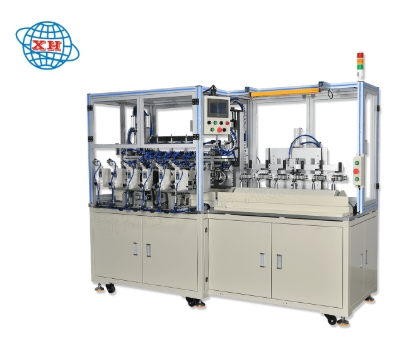
II. Key Control Aspects and Technical Solutions
(1) Dedicated Tension Control System
Functionality and Selection Criteria
Magnetic Powder Brakes/Clutches
The preferred solution! Torque is precisely controlled via current, offering fast response times (millisecond level) and making them suitable for high-speed winding. Must be matched to the wire diameter’s tension range (e.g. approximately 5–15 cN for a 0.05 mm wire diameter).
Mechanical Friction Tensioners
Low cost, but require regular calibration to account for friction pad wear. Suitable for medium- to low-speed applications; it is recommended to install a tension sensor for closed-loop feedback.
Servo-driven Pay-off
High-end solution: The pay-off spindle is driven by a servo motor, which adjusts the pay-off speed in real time via tension feedback to achieve ‘zero tension fluctuation’.
(2) Optimisation of the Wire-Guiding System
Low-friction path:
Use ceramic or polished cemented carbide guide rollers/nozzles to reduce the coefficient of friction (e.g. zirconia ceramic guide rollers have a coefficient of friction < 0.1).
Ensure the guide path contains no sharp bends (bend radius ≥ 20 times the wire diameter).
Segmented Tension Management: Install a main tensioner at the pay-off end and an auxiliary tension buffer (e.g. a spring-damped guide roller) at the fork inlet to counteract centrifugal force disturbances.
(3) Dynamic Compensation Technology
Centrifugal Force Compensation Algorithm: The higher the fork rotational speed, the greater the centrifugal force. The control system must dynamically increase the set tension according to the formula: Compensated Tension = k × ρ × r × ω² (where ρ is the linear density, r is the radius of rotation, and ω is the angular velocity).
Reel diameter adaptation: Fit an encoder to monitor the reel’s real-time diameter and automatically adjust the tension (tension for a full reel must be 30%–50% lower than for an empty reel).
III. Process Parameter Setting and Monitoring
Tension Reference Value:
Reference formula: T = (0.1–0.2) × d² (T in cN, d is the copper wire diameter in mm)
For example: 0.1 mm wire diameter → tension range 1–2 cN (subject to verification by actual measurement).
Real-time Monitoring and Feedback:
Install a miniature tension sensor (e.g. strain gauge type) at the fork inlet; data is fed back to the PLC to achieve closed-loop control.
Set threshold alarms: Automatic shutdown if tension fluctuations exceed ±15%.
Environmental Control:
Stable temperature and humidity (23±5°C, humidity 40%–60%) to prevent the varnish film from becoming brittle or sticky, which could affect tension stability.
IV. Table of Solutions to Common Problems
Wire thinning: Excessive tension or too rapid acceleration; reduce the set tension and optimise the fly-spool acceleration/deceleration curve (S-curve)
Coating scratches: Burrs on guide rollers or path deviation; replace with ceramic guide rollers and laser-calibrate the guide path coaxiality to ≤0.1 mm
Loose wire arrangement: Insufficient tension or uncompensated centrifugal force; increase base tension and enable the speed-tension linked compensation algorithm
Frequent wire breaks: Sudden changes in tension or insufficient coating toughness; check the tensioner’s response time (should be ≤10 ms) and verify the elongation of the enamelled wire (≥15%)
V. Maintenance and Verification
Daily inspections: Clean the guide wheels, check the brake for wear, and calibrate the sensor zero point.
Tension measurement: Use a handheld tension gauge (e.g. Shiba, Japan) to take random samples during production; adjust immediately if the deviation exceeds 10%.
Destructive testing: Conduct periodic sampling for winding cross-section analysis to confirm that the varnish coating shows no crushing and the copper wire shows no necking.
Final Recommendation: For precision windings (such as those in micro-motors and medical coils), prioritise the use of a servo-driven pay-off system combined with a closed-loop tension feedback system. Although the initial investment is higher, the improved yield rate will quickly recoup the costs. At the same time, establish a tension process database to store optimal parameter templates for different wire diameters, rotational speeds and formers, enabling one-click changeover between production runs.
Through the comprehensive control strategies outlined above, tension fluctuations can be kept within ±5%, significantly improving winding consistency and product lifespan.