CN

NEWS CENTER
banner
Current Position: Home > News > Industry Dynamics > How should a flying fork winding machine be maintained at the end of each cycle?

How should a flying fork winding machine be maintained at the end of each cycle?

2026-06-24 13:32:28
0

How should a flying-fork winding machine be maintained on a regular basis?


Regular maintenance of a flying-fork winding machine is key to maintaining the equipment’s precision and extending its service life. This requires systematic maintenance covering the mechanical, electrical and pneumatic (where applicable) systems. The key operational points are outlined below, categorised by maintenance cycle:


I. Daily Maintenance (to be carried out by the operator)


Cleaning and Dust Removal


Use compressed air (≤0.4 MPa) to blow away copper filings and dust from the flying fork rotation area and the wire-laying guide rails (residues from enamelled wire can conduct electricity and cause short circuits).


Wipe the surface of the tension sensor with a non-woven cloth dampened with alcohol (to prevent oil contamination from affecting detection accuracy).


Lubrication Check


Manually apply 1–2 drops of ISO VG32 guideway oil to the wire-feeding lead screw and guide rails, and check that the oil film is evenly distributed.


Check for grease seepage from the flying fork spindle (a small amount of seepage is normal; excessive seepage requires inspection of the seals).


Functional Verification


No-load operation: Test the response time of the emergency stop button and the wire break detection sensor (should be ≤0.5 s).


Tension test: Use a spring balance to pull the wire and verify the deviation between the set tension and the actual tension (tolerance: ±5%).


II. Weekly Maintenance (to be carried out by a technician)


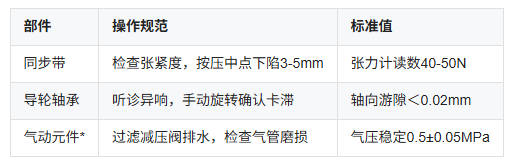
Mechanical Components


Electrical Components


Terminal tightening: Use a torque screwdriver to tighten the terminals on the motor driver and PLC (torque 0.6 N·m).


Heat dissipation cleaning: Remove the fan filter from the servo drive, clean it using an ultrasonic cleaner and allow it to air dry (replace if airflow has decreased by more than 20%).


III. Monthly Maintenance (led by an engineer)


Precision Calibration


Linear Guide Accuracy: Calibrate the positioning accuracy of the X/Y/Z axes using a laser interferometer (compensate for backlash; target ±0.01 mm).


Flywheel Balancing: Attach standard weights to test vibration levels (≤1.5 mm/s; rebalance if exceeded).


In-depth Maintenance


Grease Replacement: Inject lithium-based grease (NLGI #2) into the lead screw, removing old grease (usage: 30 g per 100 mm of travel).


Carbon Brush Inspection: Immediately replace DC motor carbon brushes if wear exceeds one-third of their original length (e.g., tension control motors).


System Backup


Export PLC programmes and servo parameters to external storage (labelled with date and model version).


IV. Quarterly/Annual Major Maintenance


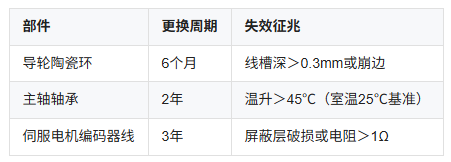
Replacement of Key Consumable Parts


V. Enhanced Maintenance for Special Operating Conditions


High-temperature environments (>35℃):

Double the frequency of cleaning the servo drive cooling fans; install a thermocouple on the controller backplate for monitoring (alarm threshold 70℃).


Fine-wire winding (wire diameter < 0.1 mm):

Inspect the guide roller edges for burrs daily using a microscope; install an anti-static ionising air gun on the tensioning mechanism.


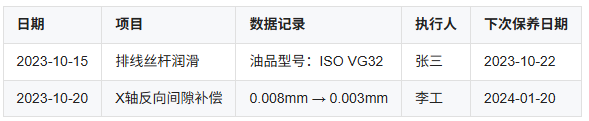
Example of Maintenance Record


It is strictly prohibited to connect or disconnect the encoder connector whilst the system is live (risk of breakdown due to induced electromotive force).


The flywheel must be mechanically locked before maintenance of the tensioning mechanism (to prevent injury from inertial rotation).


Through proper maintenance, equipment failure rates can be reduced by more than 60 per cent. Typical issues, such as cable tangling and tension fluctuations, are mostly caused by lubrication failure or a lack of calibration. It is recommended to dynamically adjust maintenance intervals based on equipment operating counters (such as the number of winding turns) to achieve predictive maintenance.


TAG

Related Products

Related News

  • Scan Wechat
  • +86 13823531619

  • xhautomatic@foxmail.com