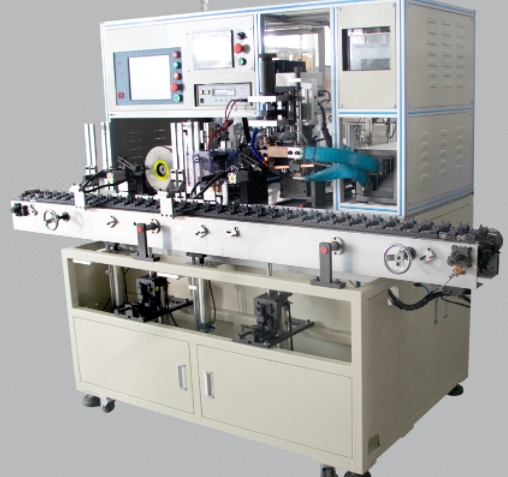
The core advantages of the micro-motor spot welding and testing integrated machine lie in its process integration, high precision, high efficiency, low cost and strong traceability, making it perfectly suited to the mass production requirements of micro-motors (particularly rotors and commutators), which are small, precise and complex.
I. Process Integration: A Single-Step Solution
Welding + Testing in One: A single machine automatically performs commutator spot welding and rotor performance testing (welding resistance, inter-tab resistance, turn-to-turn/to-ground insulation, withstand voltage, etc.), eliminating the need for two separate machines.
Reduced Re-clamping: Workpieces are positioned once to complete both processes, avoiding positioning errors and damage from manual handling, resulting in a significant improvement in yield.
Shorter Production Lines: Replaces the dual-station setup of “spot welder + tester”, saving 30%–50% of floor space, resulting in a more compact and flexible production line layout.
II. High Precision and Consistency
Welding Precision: Medium-frequency inverter power supply + servo pressure control, positioning accuracy of ±0.01 mm, pressure/current control accuracy of ±2%, minimal heat-affected zone, and no damage to enameled wire or insulation.
Testing Precision: Dedicated micro-motor comprehensive test module, resistance accuracy of ±1 mΩ, withstand voltage accuracy of ±5%, accurately identifying cold joints, false welds and insulation faults.
Closed-loop parameters: Welding current, time and pressure are linked with test data; automatic OK/NG determination eliminates human misjudgement.
III. Doubled Efficiency, Increased Production Capacity
Fast cycle time: Spot welding approx. 0.5 seconds per hook; testing ≤7 seconds per piece; overall cycle time improved by 40%–60% compared to separate equipment.
Seamless automation: Automatic loading/unloading, positioning, spot welding, indexing, testing and sorting; a single operator can oversee multiple units, with an utilisation rate of ≥90%.
Reduced waiting times: No buffering or handling between processes; zero material waiting time; smoother line flow.
IV. Cost Reduction and Efficiency Improvement, High Cost-Effectiveness
Equipment Costs: One unit replaces two, reducing procurement costs by 20%–30% whilst minimising equipment maintenance and spare parts inventory.
Labour Costs: Reduced personnel for transfer, loading/unloading and re-inspection, resulting in labour cost savings of 30%+.
Lower Energy Consumption: Medium-frequency power supply thermal efficiency of 90%–95%, offering 30%–50% energy savings compared to mains frequency, with significant long-term electricity savings.
V. Controllable Quality and Strong Traceability
Full Inspection Coverage: 100% welding and testing of every product, with automatic sorting of non-conforming items to prevent defective products from entering subsequent processes.
Data traceability: Welding parameters (current / pressure / time) and test data (resistance / withstand voltage / insulation) are automatically stored, enabling traceability down to individual workpieces, which facilitates quality analysis and the handling of customer complaints.
Anomaly alerts: Real-time monitoring of parameter fluctuations; automatic alarm and shutdown upon exceeding tolerance limits, enabling early prevention of batch defects.
VI. High Adaptability and Flexible Production
Wide-Range Compatibility: Compatible with Φ0.08–1.2 mm enamelled wire and slot-type/hook-type commutators, covering micro-motor rotors with diameters ranging from Φ6 to 50 mm.
Rapid Changeover: Parameter presets can be recalled with a single button press, with changeover time ≤ 10 minutes, making it suitable for flexible production involving multiple product varieties and small batches.
For micro-motor mass production, the spot welding and testing integrated machine is a core piece of equipment for reducing costs, improving efficiency and ensuring consistent quality. It is particularly well-suited to the integrated requirements of rotor-commutator welding and testing, and is currently the mainstream choice for smart manufacturing in the micro-motor sector.