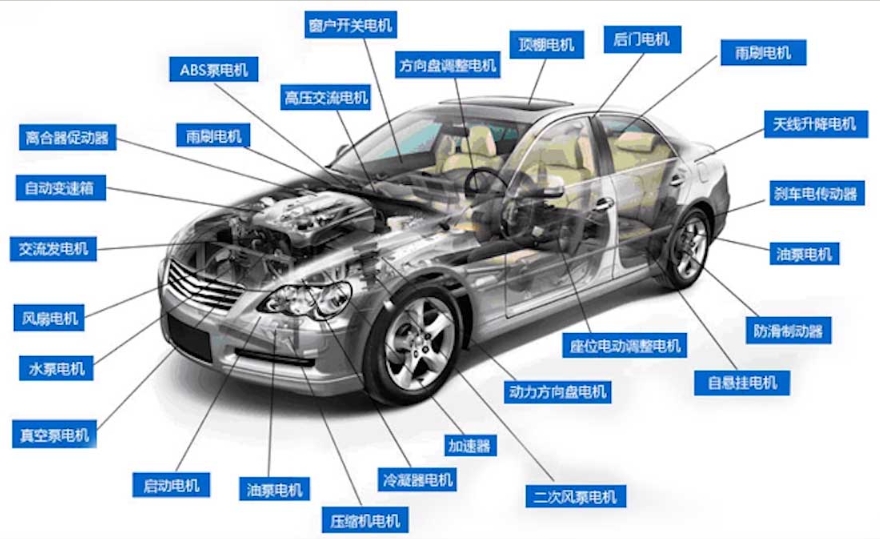
As the electrification and intelligentisation of vehicles continue to advance, the range of applications for micro-motors is expanding. In new energy vehicles, micro-motor systems serve as the core actuators for the vehicle’s electrification and intelligentisation, responsible for driving various end-effectors to enable functions such as body control, thermal management, smart cockpits and chassis protection. The number of micro-motors per vehicle has increased from 20–30 in traditional internal combustion engine vehicles to 45–60 in new energy vehicles, with high-end models featuring over 60.
I. What is an Automotive Micro-Motor System?
A Micro-Motor System (MMS) typically refers to compact motors with a power output of less than 100W, along with integrated modules that combine drive, control and sensing functions. It serves as the key interface connecting electronic control signals to mechanical movements.
The automotive micro-motor system is a vital component of the vehicle. It comprises multiple micro-motors and electric actuators used to perform various mechanical operations and control tasks. Micro-motors are usually managed by an Electronic Control Unit (ECU) or the vehicle’s computer system to achieve precise control and regulation. They support a wide range of functions and systems, characterised by miniaturisation, intelligence, multifunctionality, high integration, and suitability for mass production. They are primarily used to enhance comfort, convenience, smart and comfortable driving, and intelligent precision control.
Typical system composition:
1. Motor Unit: Generally, motors used in automotive micro-motor systems are categorised into two types: brushless DC motors and brushed DC motors. These are employed to perform functions such as the detection, analysis, amplification, execution or conversion of electromechanical signals or energy.
2. Micro Gearbox: This refers to an integrated unit comprising a reduction gearbox and a motor. It is also commonly known as a micro gear motor. It is used to reduce rotational speed and increase torque to meet the operational requirements of mechanical equipment.
3. Sensor Modules: These include Hall effect sensors, rotary encoders, temperature sensors, vibration sensors and current sensors. As a key component of micro-motor systems, they form the primary link in achieving automatic detection and control. They are responsible for capturing data on environmental or system conditions and transmitting this information to the controller system.
4. Microactuator: An essential and vital component of an automatic control system. It receives control signals from the controller, reduces speed via the micro-motor and gear transmission, and then drives the output gear to rotate. This device converts control signals into mechanical motion, generating a physical response in accordance with the controller’s signals.
5. Microcontroller: The microcontroller within an automotive controller is the core of the entire system and must possess excellent high-temperature performance and stability.
II. Applications of Micro-motor Systems in Automobiles
As one of the key systems in automobiles, micro-motor systems are primarily used in four major areas—the powertrain, chassis, electronic body control, and in-vehicle information systems—as well as in various accessories, and are gradually becoming an important component of new energy vehicle powertrains.
1. Applications in the powertrain include: vehicle starters, electronic fuel injection control systems, radiators, and alternators.
2. Applications in the vehicle chassis and frame include: electronic suspension control systems, electric power steering systems, vehicle stability control systems, adaptive cruise control (ACC) systems, and anti-lock braking systems (ABS).
3. Applications in electronic body control components include: electric sunroofs, dimmable glass, automatic headlights, smart front grilles, electric tailgates, electric door handles, charging ports, electric door latches, and electric windscreen wipers.
4. Applications in vehicle infotainment systems include: micro-motor systems are also utilised in components such as height-adjustable steering wheels, rotating screens, air conditioning/fragrance systems and smart seats.
III. The Core Value of Automotive Micro-Motor Systems
In new energy vehicles, micro-motor systems complement the main drive motor (typically ≥50 kW). Their core value is reflected in three key aspects:
l The foundational enabler of electrification: On average, each new energy vehicle is equipped with 45–60 micro-motors—more than double the number found in traditional internal combustion engine vehicles (20–30)—directly supporting the widespread adoption of electrified functions such as power windows, seats and windscreen wipers;
l Key to enhanced intelligence and energy efficiency: In smart cockpits and thermal management systems, the precise control of micro-motors can reduce energy consumption by over 12%, whilst, in conjunction with 800V high-voltage platforms, it enables a significant leap in fast-charging efficiency;
l Core guarantee of protection and comfort: Micro-motors for chassis control (such as EPS and EPB) must meet the ISO 26262 ASIL-C/D safety standards, whilst those for the body must pass IP6K9K protection certification to ensure reliable operation in extreme environments.
In summary, micro-motor systems are key to supporting the electrification, intelligentisation and safety of new energy vehicles. The performance evaluation of micro-motor systems is essential for ensuring the safety, reliability and intelligent experience of the entire vehicle.