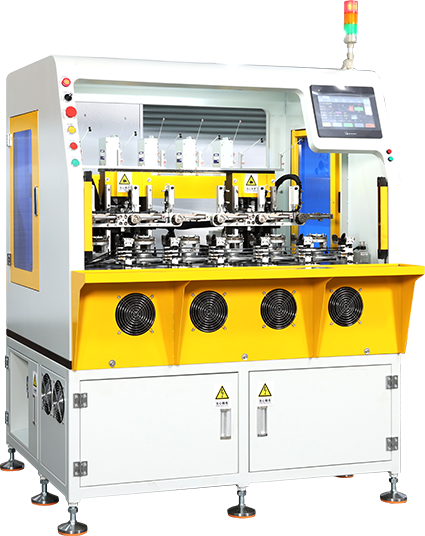
In industrial production,when a four-wire winding machine suddenly stops working,it really causes a lot of inconvenience.Not only does it affect production capacity,but it may also delay the delivery of orders.Many beginners encounter this situation and get panicked,not knowing how to troubleshoot.In fact,there's no need to panic.When a four-wire winding machine stops working,it is mostly a common minor fault,and you can solve it yourself without having to always call a maintenance technician.Today,using plain language,I will explain to you clearly the common faults,troubleshooting methods,and solution techniques.Even beginners can easily master them.
1.First,conduct three basic checks(without disassembling the machine,quickly determine the direction)
No matter what the fault is,start with a basic troubleshooting.This can solve 80%of the simple problems and prevent the need for random disassembly of the machine,which could lead to further deterioration.Remember:perform the entire operation with power completely off!
1.Check the power supply:First,make sure that the power plug of the winding machine is securely inserted,and check if the socket is powered(you can test it with other electrical appliances).Also,ensure that the power switch is turned on and that the fuse is not blown.If the fuse is broken,replace it with a fuse of the same specification and then try powering it on(do not replace it with a fuse of a different specification,as it may cause the machine to burn out).
2.Inspect the wiring:Check the wiring connections on the body of the winding machine.Look for any signs of looseness,detachment,or damage,especially the wiring between the motor and the control board.Gently press the interface with your hand to ensure a secure connection.For damaged wiring,do not power it on temporarily to avoid a short circuit.
3.Check the emergency stop and protection devices:Often,accidentally touching the emergency stop button or the machine overheating or overloading triggering the protection mechanism can also cause the machine not to start.First,press the emergency stop button and then release it to reset.Wait for the machine to cool down(if it is due to overheating protection),and then try to start it again.
II.Common Faults and Specific Solutions(Targeted Resolution)
If the initial investigation shows no issues,then proceed to the following common faults and conduct a step-by-step inspection.Each fault has a simple and easy-to-follow solution,and no professional tools are required.
Fault 1:After powering on,the machine shows no response at all;it neither lights up nor rotates.
Most likely,it is a problem with the power supply or the control board.The solution is quite simple:First,unplug and replug the power cord,and check the power supply of the socket.If the socket is powered,check the power interface of the machine to see if it is loose or oxidized.Use an alcohol cotton swab to wipe the interface and then plug it in tightly.If there is still no response,it might be that the fuse of the control board has blown or the control board is faulty.First,replace the fuse,and if that doesn't work,contact the after-sales service to test the control board.
Fault 2:The lamp lights up when powered on,but the motor does not rotate and there is no abnormal noise.
This situation is mostly caused by abnormal control signals or problems with the motor wiring.First,check the wiring on the control board to see if it is loose,especially the lines that control the motor.Tighten them and then turn on the machine.If it still doesn't move,go to the machine parameter settings to check if the"stop mode"was mistakenly set.Restore the default parameters and try again.If it still doesn't respond,it might be that the motor coil is damaged.In this case,contact a maintenance technician to test the motor.
Fault 3:The motor makes abnormal noises but doesn't rotate at all,and even gets stuck.
Check for mechanical jams or motor bearing issues,which are common faults of the four-winding loom.First,cut off the power supply,then gently rotate the main shaft of the loom by hand to see if it can rotate smoothly.If there is any jamming,it is a mechanical jam:Check if there are any foreign objects stuck in the winding shaft and gears.After clearing the foreign objects,add a little lubricating oil to the gears and guide rails,and then start the machine again to test;if it rotates smoothly but there is an abnormal noise,it is a worn-out motor bearing,and a new bearing needs to be replaced.
Fault 4:Sometimes it works and sometimes it doesn't;it's intermittent and unreliable.
This is usually caused by poor contact.Check these two areas:First,the connection points,especially for the lines that are frequently shaken,check if there is any looseness or poor contact.Reinsert and secure the lines properly.Second,the carbon brushes of the motor.Severely worn carbon brushes can cause poor contact.Open the motor housing and inspect the carbon brushes.If the wear exceeds half,replace with a carbon brush of the same specification.
Fault 5:Does not rotate when under load,but operates normally when unloaded.
This situation is caused by overload.It could be due to an excessively high winding tension setting,or too many winding turns,which result in the motor exceeding its load limit and triggering protection.Solution:Adjust the winding tension to an appropriate level to avoid excessive tension;reduce the number of turns per single winding and wind them in batches;if this still doesn't work,check if the motor power is compatible.If the motor power is insufficient,a suitable replacement motor needs to be used.
III.Essential Tips for Beginners:Warning Against Common Pitfalls
During the entire process of power-off operation,conducting electrical troubleshooting and maintenance can lead to electric shock or damage to the equipment.Therefore,you must not be lazy.
2.Do not attempt to disassemble the internal components of the machine,especially the control board and the motor.If you are not familiar with it,you may end up making the problem worse.If you still can't figure it out,just contact the after-sales service.
3.When replacing parts(such as fuses,carbon brushes,bearings,etc.),make sure to use parts of the same specification.Do not use incompatible parts to avoid damaging the machine.
In summary,the four winding machines are not rotating.First,conduct a basic troubleshooting.Then,address the common faults by identifying the root causes.Most of these issues are minor problems such as power supply,wiring,and mechanical jams.These can be handled by oneself.Regularly cleaning and lubricating the machines can also reduce the occurrence of faults and prevent production delays.