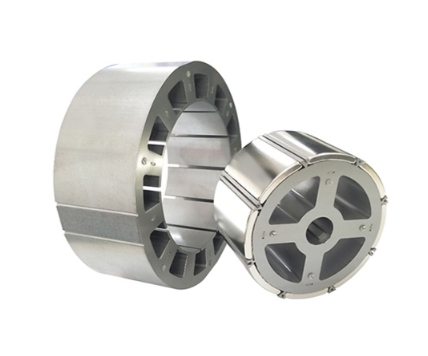
In modern industry and everyday life, electric motors—as core devices that convert electrical energy into mechanical energy—are widely used across various sectors. Within the motor, there is a component that may seem unremarkable yet is of critical importance: the motor magnetic ring. Today, we will take an in-depth look at the motor magnetic ring to understand exactly what it is, how it affects motor performance, and how to measure its key parameters.

A motor magnetic ring is a magnetic component used in motors; it is a ring-shaped magnetic conductor primarily made of magnetic materials such as ferrite or neodymium-iron-boron. Within the motor, the magnetic ring serves multiple functions, including providing a magnetic field, speed and efficiency control, filtering, and suppression of electromagnetic interference.
1. Impact on motor efficiency: A high-quality motor magnetic ring can efficiently confine and guide the magnetic field, reducing magnetic leakage and losses, thereby enabling more complete energy conversion within the motor. For example, in some high-precision servo motors, the use of high-performance magnetic rings can improve energy conversion efficiency by 10%–15%.
2. Impact on motor speed and torque: The magnetic strength and uniformity of the magnetic ring directly affect the motor’s air-gap magnetic field. If the magnetic ring exhibits magnetic non-uniformity, the motor may experience issues such as speed fluctuations and unstable torque during operation, thereby affecting the equipment’s working precision and reliability.
3. Impact on motor stability and service life: A well-designed motor magnetic ring can effectively shield against electromagnetic interference, reducing electromagnetic noise and vibration during motor operation. This enhances motor stability and extends its service life.
Measurement of Surface Magnetic Field and Magnetic Flux in Motor Magnetic Rings
As experts in automated permanent magnet measurement and control, Permanent Magnet Measurement & Control possesses core technologies including surface magnetic field, magnetic flux and magnetic torque measurement, as well as automated magnetic charging and testing. We can develop tailored magnetic field measurement and analysis solutions specifically for motor magnetic rings.
4. Surface Magnetic Field Measurement: This measurement assesses whether the distribution of magnetic field strength across the surface of the magnetic ring is uniform. An uneven magnetic field can affect operational stability. Permanent Magnet Measurement & Control offers both simple measurement instruments, such as Gauss meters, and high-end system measurement equipment, including the YC-3110, YC-3112 and YC-3113.
5. Measurement of Magnetic Flux: Magnetic flux is a core parameter determining the torque and power output of an electric motor. By measuring magnetic flux, it is possible to ensure that the magnetic performance of each magnetic ring aligns with design specifications, thereby preventing performance fluctuations between motor batches caused by variations in magnetic ring performance. Permanent Magnet Measurement & Control’s fluxmeters feature high precision, drift suppression and high stability; when paired with host computer software, they enable statistical analysis of measurement data.
Although motor magnetic rings may appear simple, they play a crucial role in the operation of the motor. Understanding the principles, performance implications and measurement methods of motor magnetic rings is of great significance for motor design, production and maintenance. Whether for motor manufacturers or end-users, the role of motor magnetic rings should be taken seriously; through the appropriate selection and accurate measurement of magnetic rings, it is possible to ensure that motors operate efficiently and stably.