CN

NEWS CENTER
banner
Current Position: Home > News > Industry Dynamics > Learn more about the basic principles of linear motors

Learn more about the basic principles of linear motors

2026-05-05 09:02:18
20

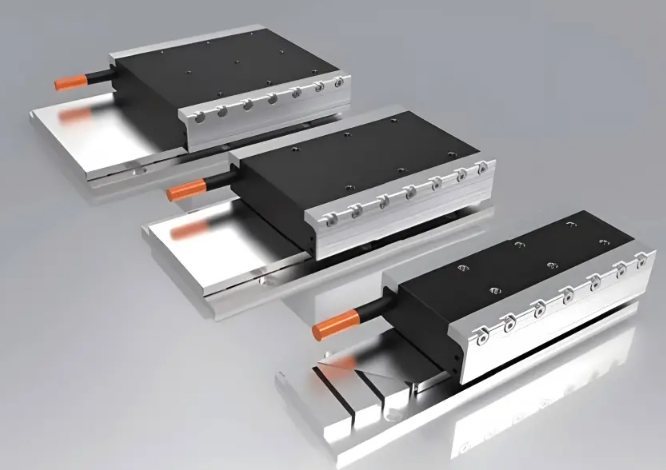
A linear motor is a device that directly converts electrical energy into mechanical energy in the form of linear motion, without requiring the intermediate transmission mechanisms (such as gears or lead screws) needed by conventional rotary motors. Its operating principle is similar to ‘unfolding’ a rotary motor into a plane, creating a linear magnetic field that drives the armature to move in a straight line. Linear motors are also known as linear actuators, linear motors, linear drives or linear actuators.

微信截图_20260505090546.png

The structure of a linear motor primarily comprises three parts: the stator (primary), the armature (secondary) (with permanent magnets arranged in an N-S-N-S sequence; the number of poles depends on the stroke length of the designed linear motor), and the linear motion support assembly. Similar to a rotary motor, when a linear motor is connected to three-phase AC power, a magnetic field is generated in the air gap between the primary and secondary coils. If end effects are disregarded, this magnetic field should exhibit a sinusoidal distribution in the linear direction; however, as this field translates rather than rotates, it is also referred to as a travelling wave field. The interaction between the travelling wave field and the secondary coil generates electromagnetic thrust.


The operating principle of linear motors is based on electromagnetic induction and electromagnetic forces. They are primarily classified into three types: linear induction motors, linear synchronous motors and stepper linear motors. The core operating principles are as follows:


1. Linear synchronous motor (LSM): The stator magnetic field operates in synchronisation with the rotor magnetic field. By controlling the speed at which the stator magnetic field moves, the motion speed is precisely controlled. This type is commonly used in applications requiring high speed accuracy, such as high-speed maglev trains.


2. Linear Induction Motor (LIM): The rotor magnetic field operates out of phase with the stator magnetic field, relying on electromagnetic induction to generate thrust. With a simple structure and lower cost, it is frequently used in medium- and low-speed maglev railways and linear motor rail-based transport systems.


3. Stepper Linear Motor (LPM): Controlled by pulse signals to achieve precise stepper motion, suitable for applications requiring high-precision positioning and control, such as automated equipment and CNC machine tools.


Key Features:


1. Linear motors require no intermediate transmission mechanisms, directly converting electrical energy into linear mechanical energy. They offer advantages such as high precision, high speed, low wear and low noise.


2. By adjusting the power supply frequency, phase sequence or secondary materials, the speed and direction of motion can be controlled.


Currently, linear motors are widely used in mechanical devices such as industrial robots, machine tools and laser processing equipment. For example, robotic arms are used in the mechanical manufacturing sector to replace human labour in high-volume, high-quality tasks, such as in automotive and shipbuilding. Another example is the linear compressor used in small cryogenic refrigeration systems for aerospace or military applications. Furthermore, laser cutting machines, which have replaced traditional cutting equipment, are now widely used across various industries requiring precise cutting. As they utilise a new type of reluctance linear motor drive, they feature a simple structure, are easy to operate, and offer high efficiency and energy savings.

TAG

Related Products

Related News

  • Scan Wechat
  • +86 13823531619

  • xhautomatic@foxmail.com