CN

NEWS CENTER
banner
Current Position: Home > News > Industry Dynamics > How do brushless motors achieve commutation?

How do brushless motors achieve commutation?

2026-04-27 09:33:08
5

Commutation principle of brushless motors (BLDC): Completely eliminating carbon brushes and relying on electronic commutation


Brushed motors: Commutation via mechanical friction between carbon brushes and the commutator; Brushless motors: No physical commutation mechanism; rely on Hall sensors / back-EMF sampling + drive controller (ESC) + three-phase inverter circuit to sequentially switch the energisation sequence of the three-phase coils, thereby achieving continuous rotation.

微信截图_20260427092656.png


I. Key Structural Differences

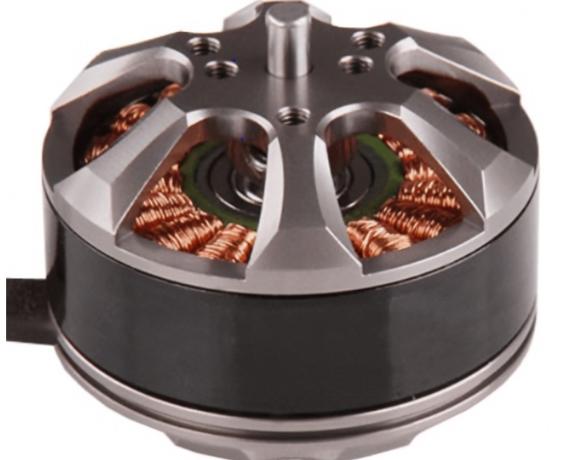
Stator: Windings for three-phase coils A/B/C (fixed in position)

Rotor: Permanent magnets (rotating N/S poles)

Key: Controller + position detection = core of electronic commutation

WeChat screenshot_20260427092656.png


II. Basic Operating Logic

The position of the rotor’s permanent magnets is fed back to the controller in real time;

The controller alters the direction of current in the three-phase windings and the sequence of energisation in sequence based on the rotor’s angle;

This ensures that the rotating magnetic field generated by the stator always leads the rotor’s magnetic field by a specific angle;

The continuous attraction and repulsion of the magnetic fields drive the rotor to rotate continuously, replacing mechanical commutation.


III. Two Mainstream Commutation Methods

1. Inductive Commutation (with Hall sensors, most commonly used)

Three Hall elements are built into the stator to detect the positions of the rotor’s N and S poles in real time;

The Hall sensors output high and low voltage signals to inform the controller of the rotor’s current position;

The controller pre-sets six energisation combinations (six-step commutation) and, based on the Hall signals, sequentially activates the MOSFETs to switch the A/B/C phase currents;

Advantages: Smooth low-speed start-up, high torque, simple control;

Applications: Automotive motors, water pumps, fans, industrial brushless motors.

2. Sensorless Commutation (Hall-less, Back-EMF Detection)

No position sensors; relies on **back-EMF (BEMF)** to determine the rotor’s position;

When the motor rotates, the non-energised phases generate an induced voltage; the controller samples the waveform to determine the angle;

Disadvantages: Unstable at low speeds and during start-up; requires pre-positioning for forced start-up;

Suitable for: fans in small household appliances, low-speed equipment, and scenarios with high cost requirements.


IV. Additional Key Points (Practical for Motor Production/Repair)

1. Brushless motors cannot be directly connected to AC or DC power; they must be paired with a driver, otherwise they will not rotate;

2. Incorrect Hall sensor wiring or phase misalignment will result in vibration, lack of torque, reverse rotation, and overheating;

3. The principle of variable-frequency drives is fundamentally the same, essentially involving electronic commutation and vector control, which are also the core reasons for the high efficiency and low heat generation of brushless motors.

TAG

Related Products

Related News

  • Scan Wechat
  • +86 13823531619

  • xhautomatic@foxmail.com