Differences and Selection Between 2-Pole and 4-Pole Motors
In industrial production and daily life, as a core component of the power source, the selection of motors directly affects equipment performance and operational efficiency. Among them, 2-pole and 4-pole motors, as typical representatives of asynchronous motors, are suitable for different scenarios due to their distinct speed characteristics. This paper systematically analyzes the differences between the two from the perspectives of structural principles, performance features and practical application scenarios, and provides scientific selection recommendations.
1. Essence of Structural Design and Speed Differences
Physically, the fundamental difference between 2-pole and 4-pole motors lies in the number of pole pairs in the stator winding. A 2-pole motor generates one pair of magnetic poles (N and S poles) in its stator winding, while a 4-pole motor forms two pairs. This structural difference directly results in a significant gap in synchronous speed. According to the formula
n=60f/p (where
f is the power frequency and
pis the number of pole pairs), at a 50Hz industrial frequency, the synchronous speed of a 2-pole motor reaches 3000 rpm, with an actual speed of approximately 2850–2950 rpm; the synchronous speed of a 4-pole motor is 1500 rpm, with an actual speed of about 1440–1480 rpm. Notably, this speed difference is achieved naturally through electromagnetic fields rather than gear shifting, allowing 4-pole motors to maintain higher energy conversion efficiency during low-speed operation.
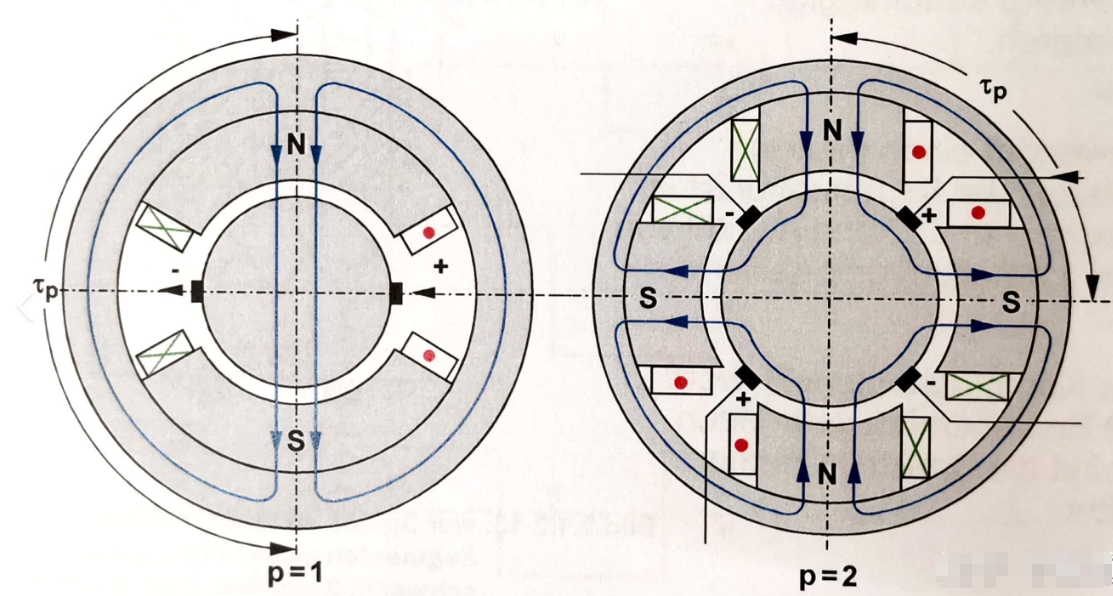
2. Comparative Analysis of Performance Parameters
Torque CharacteristicsOwing to the higher frequency at which the rotor conductors cut magnetic lines of force, 4-pole motors can produce 30%–50% higher starting torque than 2-pole motors at startup. Test data for a fan load shows that the starting torque of a 4-pole motor of the same power reaches 2.2 times its rated value, whereas that of a 2-pole motor is only 1.6 times, making 4-pole motors more advantageous for heavy-duty starting applications such as crushers and compressors.
Efficiency and Temperature RiseAlthough 2-pole motors feature high speed and compact size, their rotor windage loss increases by approximately 15%, and bearing temperature rise is more pronounced under high-speed operation. Field measurements indicate that the winding temperature rise of an 11kW 4-pole motor during continuous operation is 8–12°C lower than that of a 2-pole motor of the same power, making it more suitable for long-term continuous duty cycles.
Vibration and NoiseDue to lower rotational speed, the mechanical vibration frequency of 4-pole motors is closer to the human comfort range. Laboratory tests show that under identical installation conditions, the sound pressure level of 4-pole motors is on average 5–8 decibels lower than that of 2-pole motors, which is particularly critical for quiet environments such as hospitals and office buildings.
3. Precise Matching of Application Scenarios
3.1 Advantageous Fields for 2-Pole Motors
High-speed centrifugal equipment: including air conditioning compressors and centrifugal water pumps. A 7.5kW centrifugal water pump of a certain brand achieved a 22% increase in flow rate after adopting a 2-pole motor.
Space-constrained applications: hydraulic pump stations of injection molding machines using 2-pole motors can reduce installation space by 30%.
Intermittent duty equipment: traveling mechanisms of cranes utilize their high speed for rapid positioning.
3.2 Applicable Conditions for 4-Pole Motors
High-inertia load starting: the starting time of a ball mill was shortened from 45 seconds to 28 seconds after using a 4-pole motor.
Precision transmission systems: winding devices of textile machinery achieve a speed control accuracy of ±1 rpm via 4-pole motors.
Long-term continuous operation: a chemical plant reduced annual failure rates by 40% after replacing 2-pole motors with 4-pole models.
4. Five Key Factors for Selection Decisions
Load Characteristic MatrixFor constant-torque loads (conveyors) and quadratic-torque loads (fans), 4-pole and 2-pole motors are recommended respectively. A fan renovation project at a cement plant achieved annual power savings of 32,000 kWh after switching to 2-pole motors.
Energy Efficiency Rating ConsiderationUnder the current GB 18613-2020 standard, there are 12 more specifications of IE4 energy-efficient 4-pole motors than 2-pole motors, with more prominent efficiency advantages in power segments above 75kW.
Cost-Benefit AnalysisAlthough the procurement cost of 4-pole motors is 8%–15% higher, their maintenance costs over a 10-year service life can be reduced by 25%. A full-life-cycle cost calculation for a wastewater treatment plant confirmed total cost savings of 180,000 yuan with 4-pole motors.
Environmental Adaptability4-pole motors are recommended for plateau areas (altitude > 1000m), as their heat dissipation capacity is 20% higher than that of 2-pole motors, effectively compensating for reduced cooling efficiency caused by thin air.
Intelligent Control RequirementsIn variable-frequency drive applications, 2-pole motors maintain better performance in the 50–100Hz range, while 4-pole motors deliver more stable torque output in the low-frequency band of 5–50Hz. An intelligent production line achieved optimal energy efficiency through a mixed configuration of both motor types.
5. New Trends in Technological Development
With the popularization of permanent magnet synchronous motors, new dimensions have emerged in the pole selection of traditional asynchronous motors. The newly developed pole-changing motors (such as switchable 6/8-pole models) have been successfully applied to wind turbine pitch systems, with a switching response time reduced to 0.3 seconds. In addition, 4-pole motor rotors made of polymer composite materials reduce the moment of inertia by 15%, combining the dynamic response characteristics of 2-pole motors.
In practical selection, a three-dimensional evaluation method of "load characteristics–operating duration–environmental conditions" is recommended, and prototype testing can be conducted if necessary. A stamping production line at an automobile factory finalized a 2:3 pole ratio scheme after a three-month comparative test, achieving the optimal balance between energy consumption and efficiency. This indicates that motor selection is both a science and an art, requiring optimal decisions based on comprehensive technical