Advantages and Disadvantages of High-Voltage Motors Compared with Low-Voltage Motors
High- and low-voltage motors are selected according to their different performances and characteristics in various production environments, so as to achieve the highest speed and efficiency.
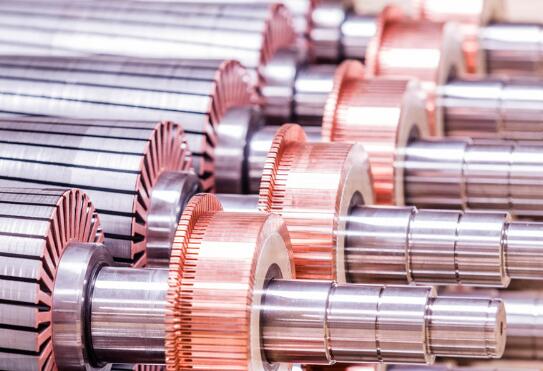
A low-voltage motor refers to a motor with a rated voltage lower than 1000V, while a high-voltage motor is one with a rated voltage equal to or higher than 1000V.
They differ in rated voltage, starting and operating current — the higher the voltage, the smaller the current. Their insulation and voltage resistance levels are also different, as are the conductors used in motor windings. For motors of the same power, high-voltage motors use thinner conductors and different cables.
Both high-voltage and low-voltage motors have their own advantages and disadvantages. So, in what aspects are their respective strengths and weaknesses reflected?
High-Voltage Motors
Generally, motors supplied with a voltage of 3kV to 10kV are regarded as high-voltage motors. Commonly used models are 6300V and 10000V motors. Motor power is proportional to the product of voltage and current. Therefore, when the power of a low-voltage motor increases to a certain level (e.g., 300kW at 380V), its rated current becomes very large, and line loss increases in proportion to the square of the current (I²R). This requires a large cross-sectional area of conductors, which limits the cable carrying capacity and leads to excessively high costs. In such cases, higher rated voltage is required to achieve high-power output.
Low-Voltage Motors
Low-voltage motors are those with an AC voltage below 1000V, generally referring to 380V AC motors. Asynchronous motors of other ratings such as 440V or 660V are rarely used in practice. Low-voltage motors are divided into AC asynchronous motors and DC motors.
Asynchronous motors are defined in contrast to synchronous motors. The synchronous speed of a synchronous motor is calculated by the formula n0=60f/p, where f is the power frequency and p is the number of pole pairs of the motor. Since the actual speed of a general motor is lower than its synchronous speed, it is called an asynchronous motor, meaning there is a speed difference and the rotor is not synchronized with the magnetic field.
Advantages of High-Voltage Motors Compared with Low-Voltage Motors
They can be designed to very high power levels, up to thousands or even tens of thousands of kilowatts.At the same output power, the current of a high-voltage motor is much smaller than that of a low-voltage motor (approximately inversely proportional to voltage). For example, the rated current of a 500kW 4-pole motor is about 900A at 380V, but only about 30A at 10kV. Thus, high-voltage motor windings use smaller wire diameters, resulting in lower stator copper losses than low-voltage motors. For large-power motors, low-voltage operation requires thick conductors and large stator slots, leading to a larger stator core diameter and overall motor size.
For large-capacity motors, the overall investment in power supply and distribution equipment for high-voltage motors is lower than that for low-voltage motors, with lower line losses and reduced power consumption.Especially for 10kV high-voltage motors, they can be directly connected to the utility grid (the high-voltage power supplied to users in China is generally 10kV), reducing investment in power supply equipment (mainly transformers), simplifying operation, and lowering failure rates.
Disadvantages of High-Voltage Motors Compared with Low-Voltage Motors
The cost of windings is relatively high, mainly due to insulation requirements, along with higher costs of related insulation materials.
Insulation processing is more difficult and involves higher labor costs.
Requirements for the operating environment are much stricter than those for low-voltage motors.
Main Structural Differences
Insulation materials for coilsLow-voltage motor coils mainly use enameled wire or simple insulation such as composite paper. High-voltage motor insulation usually adopts a multi-layer structure, such as mica tape, which is more complex and has higher voltage resistance.
Heat dissipation structureLow-voltage motors mainly use coaxial fans for direct cooling. Most high-voltage motors are equipped with independent radiators, usually with two sets of fans: one for internal circulation and one for external circulation. Both operate simultaneously to exchange heat through the radiator and discharge heat outside the motor.
Bearing structureLow-voltage motors usually have one set of bearings at each end. High-voltage motors, due to heavy loads, generally have two sets of bearings at the shaft extension end; the number of bearings at the non-shaft extension end depends on load conditions. Extra-large motors often use sleeve bearings.
Comparison of Motor Operation and Costs
The higher the voltage level, the larger the motor capacity.
The higher the voltage level, the higher the installation cost. Although higher voltage reduces current and allows smaller conductors and cables, expenses for high-voltage circuit breakers, transformers, switch cabinets and other equipment increase, resulting in higher initial investment. Therefore, small enterprises tend to use low-voltage equipment for new construction.
The higher the voltage level, the lower the overall operating cost. Lower current reduces power loss, which is economically favorable in the long run. The accumulated power savings are significant, so many large enterprises retrofit low-voltage motors to high-voltage motors during technical upgrades.
The higher the voltage level, the more space is occupied, mainly due to high-voltage control cabinets.
The higher the voltage level, the easier starting and control become, with increased starting torque and simpler starting and control systems.
The higher the voltage level, the more complex maintenance and management become. For this reason, small enterprises prefer low-voltage motors while large enterprises choose high-voltage motors.