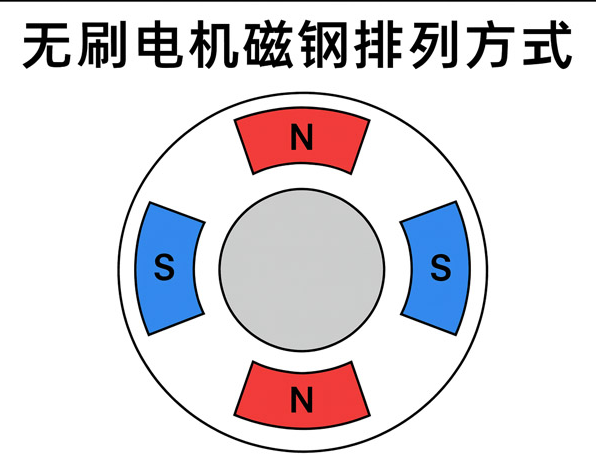
In brushless DC motors (BLDC), magnets are one of the core components that determine the motor’s performance. Correct magnet installation not only affects the motor’s efficiency, noise levels and service life, but also directly impacts safety during high-speed operation. Therefore, a series of technical requirements must be strictly adhered to during the production and assembly processes. Below is a professional summary of the most critical considerations regarding magnet installation in brushless motors.

Magnet polarity must be correct and arranged consistently
The magnets in a brushless motor are typically arranged in an equidistant alternating N-S-N-S pattern. If a single magnet is installed with the polarity reversed, the magnetic field generated by the stator coils will be unable to correctly commutate with the rotor magnetic field. At best, this results in a ‘humming’ noise and torque fluctuation; at worst, the motor fails to start, or the drive MOSFETs may be damaged by overcurrent. Consequently, the polarity of each magnet must be checked prior to installation to ensure that the orientation is entirely consistent.
The gaps between magnets (pole spacing) must be consistent
The gaps between magnets effectively determine the uniformity of the air gap magnetic field. If any magnet is positioned too close or too far away, it will cause magnetic field distortion, leading to issues such as torque pulsation, increased noise and reduced efficiency. High-speed motors are more likely to experience vibration due to imbalance; in severe cases, this can result in ‘stator winding contact’, directly damaging the stator windings.
The thickness and dimensions of the magnets must be consistent
Brushless motors have extremely high requirements for rotor dynamic balance, and the magnets are one of the key factors directly affecting this balance. If the thickness of the magnets is inconsistent or the mounting height varies, the rotor will become eccentric. As rotational speed increases, vibration becomes more pronounced, not only increasing noise but also accelerating bearing wear and potentially shortening the overall service life of the motor.
Magnet bonding must be secure, and the adhesive must be fully cured
Magnets are subjected to immense centrifugal forces during high-speed operation; therefore, high-strength, heat-resistant adhesives—such as epoxy AB resin or high-temperature structural adhesives—must be used, and the adhesive must be allowed to cure fully after installation.
The installation angle must be precise, and the fit must be tight
Curved magnets must fit snugly against the outer circumference of the rotor core to prevent tilting or misalignment. If the magnets are not installed at the designed angle, the air gap magnetic field distribution will shift, leading to distortion of the back-EMF waveform, reduced motor efficiency and increased heat generation. These latent effects often become apparent only after prolonged operation.
Specialised positioning jigs must be used during installation
Manual installation of magnets is prone to positional deviations; therefore, in mass production, positioning tools or jigs must be utilised to ensure that each magnet is arranged at equal distances and with consistent angles. This effectively reduces vibration and improves consistency, and is essential for high-end brushless motors.