Variable Flux Machines (VFM) are a new class of motors capable of dynamically adjusting the strength of the magnetic field in the rotor air gap. Their primary objective is to optimise the efficiency of electric vehicles under various operating conditions. Through the synergy of hardware design and intelligent control, they achieve a seamless transition from a strong magnetic field at low speeds to a weak magnetic field at high speeds, thereby addressing at the root the —‘high efficiency at low speeds but high power consumption at high speeds’—at its root. By balancing power output with energy efficiency, it represents a core technological advancement in the field of new energy propulsion.
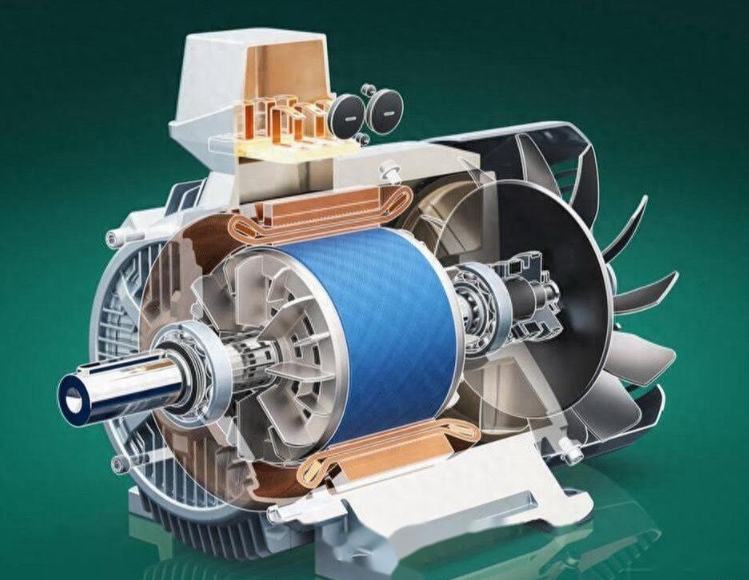
I. Technical Principles and Operating Mechanism
Current mainstream electric vehicles generally employ permanent magnet synchronous motors, in which the rotor magnetic field strength remains fixed. Whilst this design offers extremely high efficiency and ample torque at low speeds, it generates a powerful counter-electromotive force within the motor during high-speed operation. To maintain high rotational speeds, the electronic control system must consume additional current to counteract this resistance, resulting in a significant drop in motor efficiency and a sharp rise in energy consumption.
Variable flux motors achieve intelligent regulation of the motor’s magnetic flux by incorporating technologies such as magnetic field modulation, magnetic circuit switching or auxiliary excitation. This enables the motor to automatically switch operating modes based on vehicle speed and load, switching to a weak magnetic field at high speeds to reduce counter-electromotive force and iron losses, thereby achieving high-efficiency operation across the entire speed range:
1. Low-speed/high-load conditions (e.g. starting, hill climbing): The system increases the magnetic field strength (strong-field mode) to provide greater torque and a more responsive acceleration.
2. High-speed cruising conditions: The system reduces the magnetic field strength (weak-field mode), thereby effectively lowering back-EMF and reducing ‘internal energy loss’, enabling the motor to maintain high efficiency even at high speeds.
II. Main Implementation Methods
3. Mechanical magnetic field adjustment: This method regulates magnetic flux by altering the magnetic circuit’s magnetic resistance via mechanical devices. For example, movable magnetic conductors are positioned at the axial ends or within the rotor; these are driven by hydraulic, centrifugal or gear mechanisms to change the magnetic flux short-circuit path, thereby adjusting the air-gap flux.
4. Electromagnetic Magnetic Field Adjustment (Memory Magnetic Field Adjustment): This method utilises permanent magnet materials with low coercivity (such as AlNiCo or SmCo). By applying pulsed currents through the stator windings, the rotor magnets are magnetised or demagnetised online, altering the rotor’s remanence state to achieve adjustment of the magnetic field strength.
III. Advantages of the Motor
5. Improved Efficiency: During high-speed cruising, no significant weak-field current is required, allowing efficiency to be maintained at 92%–95%, significantly reducing energy consumption and extending the driving range.
6. Broader constant-power range: Maintains high power output across a wider speed range, balancing low-speed torque with high-speed stability.
7. Reduced risk of demagnetisation: Reduces the thermal load on permanent magnets, minimising the likelihood of irreversible demagnetisation and enhancing motor reliability.
8. Optimised system costs: Permits the use of permanent magnet materials with slightly lower magnetic strength and lower temperature requirements, reducing demands on the inverter’s weak-field capability.
Variable flux motors, with ‘dynamically adjustable flux’ as their core innovation, have perfectly resolved the efficiency imbalance across all operating conditions that plagues traditional permanent magnet synchronous motors through technical approaches such as mechanical or electromagnetic flux control. Combining high-speed efficiency, wide-range constant power, high reliability and cost advantages, they not only meet the dual demands of new energy vehicles for power and energy efficiency but also drive the technological advancement of new energy drive systems. In the future, they are expected to become the mainstream configuration for drive motors in mid-to-high-end electric vehicles, leading the development of new energy vehicle powertrain technology. Flux and magnetic field measurements, as key supporting technologies, provide precise data for motor design verification, performance calibration and reliability assurance.